
What Is Dezincification, and Why Do Brass Fittings Split?
Dezincification is the selective loss of zinc from a brass fitting, leaving a porous copper skeleton that keeps its original shape but has almost no mechanical strength. That is why a failing fitting looks perfect and passes the pressure test on installation day, then splits many months later when something knocks it.
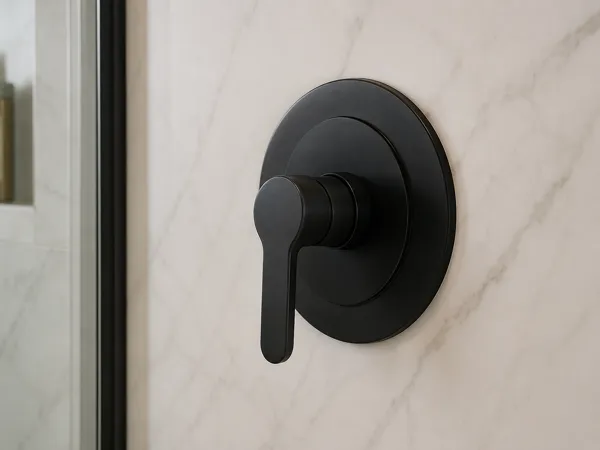
Almost nothing in this article is visible after the wall closes, which is precisely why it is worth reading before it does. The parts inside a wall are chosen once and reached again only by taking the wall apart.
What is actually happening to the metal?
Brass is an alloy of copper and zinc. Under the wrong water conditions the zinc leaches out of it selectively and leaves behind a porous copper structure that, in the words of one corrosion guide, “retains the original shape but has negligible mechanical strength.”
The shape is intact. The strength is gone. That is exactly why it passes inspection on the day and fails later, and why the failure looks sudden when it is not.
There are visible signs, if anybody is looking: a white zinc oxide deposit, a reddish cast to the metal, or weeping at a joint nobody has touched.
Two patterns, and the second is worse
Layer-type dezincification spreads evenly across the surface. Plug-type eats a localised channel straight through the wall of the fitting. The same guide calls plug-type “more dangerous because the rest of the part still looks intact. Pressure-bearing fittings can fail catastrophically through a plug.”
What makes it happen faster?
The published risk factors are consistent: low pH below 7.0, elevated chloride above roughly 100 mg/L, elevated temperature above 60 °C, soft water, dissolved oxygen, and stagnant or slow-moving water.
That last one deserves a moment. A guest bathroom used twice a month is a textbook case — the water sits still in the fitting for weeks at a time. The rooms that get the least use are not the rooms at the least risk.
Is all brass the same?
No, and the alloy designation is effectively the whole story. It comes down to how much zinc is in the mix:
- CW617N — about 40% zinc — fails the dezincification test
- CW614N — about 39% zinc — fails
- CW602N, arsenic-inhibited — about 36% zinc — attack depth 200 micrometres or less
- C69300 / CW724R, silicon — about 21% zinc — 100 micrometres or less
- Pure copper — no zinc — immune
The test behind those figures is ISO 6509-1: a polished cross-section sits in copper chloride at 75 °C for twenty-four hours, and the depth of attack is measured. Passing correlates with more than thirty years of service in corrosive drinking water, according to the studies the mills reference.
So the word “brass” on a specification sheet, with no grade attached, tells you very close to nothing.
Does an NSF mark answer this?
This is the genuinely surprising part, and the reason to read a specification sheet rather than a sticker. You will see NSF certifications on plumbing parts and reasonably assume they mean the part is sound. What they actually cover is narrower:
- NSF/ANSI 61 tests what the material leaches into your drinking water
- NSF/ANSI 372 tests that lead is at or below 0.25% on wetted surfaces
Neither is a corrosion test. A fitting can carry a valid NSF 61 listing and a valid lead-free mark under 372 and still be made from a brass that will dezincify, because neither certification looks for it.
Two marks, both real, both meaning what they say — and neither answering the question that decides whether the part survives inside your wall.
Is the right alloy enough on its own?
No — and this is the second trap. Resistance comes from the alloy and a subsequent heat treatment, in the order of two hours at 500 to 550 °C once the part has been forged. Diehl, a manufacturer of dezincification-resistant brass, put it unambiguously in their own literature: rod and profile supplied as pre-material for forgings is “not dezincification-resistant in the as-delivered state.”
So the right metal, processed wrong, is not the right metal. Which means the question to ask about a fitting is not only what it is made of, but whether it was finished correctly.
What about plastic and zinc alloy?
Plastic costs less and is immune to this particular failure, which sounds decisive until you ask how it does fail instead. Years of heating and cooling make it progressively brittle, and it is vulnerable to chemical attack. You have traded a corrosion problem for a fatigue one.
Zinc alloy — Zamak — performs worst of the three in plumbing service, and it is what sits under the finish on a great deal of decorative bathroom hardware. Its characteristic weakness is porosity: as the casting cools, trapped gas and air leave voids through the metal. Under a sound coating that is survivable. Under a failing one it is not, because the substrate brings no corrosion resistance of its own to fall back on.
Our Warranty
Lifetime warranty covering plumbing, wall systems, fixtures, shower pan, doors and installation. Transferable to a new owner, backed by RenewItHQ, documented in writing. Only exclusion is customer damage.
What will we actually claim?
We are not going to name an alloy grade for parts we do not hold a mill certificate for. That would be precisely the kind of claim this article is telling you to distrust, and we would rather lose the sentence than make it.
What we can point at is published by the manufacturer: Delta’s specification sheet for the valve body we install states a forged brass body. Forged, not cast. That is on their document rather than ours, and you can ask to see it.
What should you ask whoever is quoting you?
Two questions, and they work on any remodeler including us:
- What is going in the wall — the actual make and model, not the category?
- Can you show me the manufacturer’s specification sheet for it?
A specification sheet is a document that already exists. Nobody has to write anything, look anything up, or promise anything. Either it can be produced or it cannot, and that in itself is informative.
Whatever ends up behind the wall on our jobs, the coverage names both plumbing and installation, which is the point of putting it in writing.
Talk It Through in Your Own Bathroom
We look at the space, answer the questions this guide raised, and explain the options that fit your home.

Ready When You Are