
Why Do Some Bathroom Finishes Wear Out Faster Than Others?
A bathroom finish is a coating, and the process used to apply it decides how long it survives. Under ASTM B117 salt-fog testing, decorative chrome reaches base-metal exposure between 96 and 250 hours, while a PVD coating on the same part runs 1,000 to 2,400 hours. The fixtures look identical in a showroom. They do not age alike.
Every fixture in a bathroom is a piece of metal with something on top of it. The metal underneath is often similar from one price bracket to the next. What separates a fixture still looking new after a decade from one pitting at year six is the process that applied the finish — and that process is invisible once the part is boxed.
This matters more than most finish decisions because it is the part of a bathroom you touch every day and the part you cannot repair. A damaged wall panel can be replaced. A finish that has worn through is the fixture’s life ending.
What is actually on the metal?
Three common answers, and they are not variations on a theme. They are different manufacturing processes with different failure modes.
Electroplated chrome
The oldest and still the most common. The part passes through chemical baths that deposit metal in layers. On a typical zinc die-cast part the stack comes out at roughly 8 microns of copper, 12 microns of nickel and 0.3 microns of chrome on top, with hardness around 500 to 850 HV.
Read that stack again. The chrome you are looking at is three tenths of one micron. Nearly all the protection is the nickel underneath it.
PVD — physical vapour deposition
A dry vacuum process rather than a wet one. A solid target of titanium, zirconium or chromium is vaporised inside a chamber and deposited on the part atom by atom, forming a molecular bond with the metal rather than a layer resting on it. Hardness lands between 1,500 and 4,600 HV depending on the chemistry.
One consequence is worth knowing before you choose it: a PVD coating cannot be stripped and reapplied. Damage is rare, and permanent when it happens.
Powder coat
A thick polyester layer, around 70 microns, baked over an electrocoat. Genuinely tough and far thicker than the alternatives. Its limitation is structural rather than a matter of quality — it is a coating sitting on the part, so it chips rather than wearing gradually.
How is a finish actually tested?
Two standardised tests do most of the work, and both have names you can look up rather than take on trust.
ASTM B117 is the salt-fog test. The part sits in a sealed chamber fogged continuously with a 5% salt solution at 35 °C, compressing years of corrosive exposure into hours. The number that matters is how many hours pass before base metal is exposed: 96 to 250 for decorative chrome, 1,000 to 2,400 for PVD.
ASTM D4060 is the Taber abrasion test, which measures scratch resistance rather than corrosion. On that measure the gap is again wide: somewhere between ten and twenty times, in PVD’s favour, against electroplated chrome.
Those describe two different ways a finish dies — one is water and air, the other is the cleaning cloth and the wedding ring. A fixture has to survive both.
Does the metal underneath matter as much as the coating?
It matters more than most people expect, and it is the variable buyers most often miss. A PVD coating on solid brass outlasts an electroplated coating on zinc alloy by a wide margin. Budget fixtures built on a zinc alloy base tend to fail within two to five years more or less regardless of what was sprayed or plated onto them.
The reason is that once plating fails on a zinc casting, the base metal has no corrosion resistance of its own to fall back on. On brass it does. So “is it PVD?” is only half the question. The other half is “what is it PVD on?”
What does that mean in East Texas years?
Laboratory hours are not years and nobody should convert one straight into the other. What exists is published service-life banding for an inland bathroom, which is what we have here — no coastal salt air, but real humidity for months at a time.
- Decorative chrome: 5 to 8 years
- Powder coat: 6 to 10 years
- Brushed nickel on 304 stainless: 8 to 12 years
- PVD: 10 to 15 years
Roughly a decade separates the top of that list from the bottom. On a remodel you intend to keep, that is the difference between choosing a finish once and choosing it twice.
How should each finish be cleaned?
This is where a Care & Maintenance answer earns its place, because the finishes fail differently and the wrong cleaner accelerates all of them.
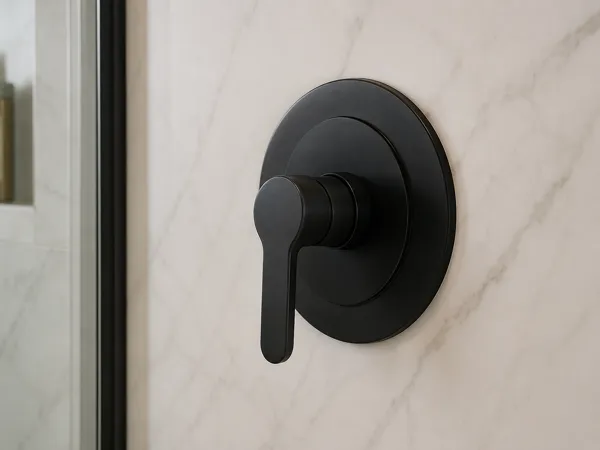
- Matte black is typically a powder coat, and it hides marks better than anything else in the bathroom. It is also the most vulnerable to abrasive cleaners, vinegar and bleach. Warm water and a soft cloth is genuinely the whole method.
- Brushed finishes hide water spots and fingerprints because of the texture. Work along the grain, not across it.
- Polished chrome shows spots and prints more visibly than any other finish, which is a cosmetic issue rather than a durability one — but it is why chrome gets scrubbed more often, and scrubbing is what its 0.3 micron top layer likes least.
Nothing in that list requires a specialist product. What it requires is not reaching for an abrasive.
Is there a test you can do yourself?
There is, and it is the one commercial buyers use. A sample-approval procedure described by a faucet manufacturer amounts to this: take a ball of steel wool and scrub the new fixture vigorously.
On an electroplated finish that leaves a web of fine scratches almost immediately. On a good PVD finish it does close to nothing. That is not a laboratory result. That is somebody deciding whether to sign a purchase order.
You are unlikely to be handed steel wool in a showroom. You can still put your hands on a finish, and you can still ask which process applied it — the answer sits on the manufacturer’s documentation rather than on ours.
Our Warranty
Lifetime warranty covering plumbing, wall systems, fixtures, shower pan, doors and installation. Transferable to a new owner, backed by RenewItHQ, documented in writing. Only exclusion is customer damage.
Why is the cheaper finish everywhere?
Equipment cost, mostly. Vacuum deposition requires a chamber costing millions; plating requires tanks and a rectifier, and the industry has spent a century making that cheap at volume. There is a commercial logic on top of it: the coating is the last thing most buyers examine, and the last thing examined is the easiest place to economise. Nothing about that decision is visible in a showroom. It becomes visible in year seven.
Which finishes does RenewItHQ install?
We install Delta fixtures. Delta’s Brilliance finishes — Champagne Bronze, Brushed Nickel and Stainless — are PVD, described on Delta’s own product documentation with the phrase “This process is known as Physical Vapor Deposition.” Delta were the first faucet manufacturer to offer it. Their chrome, by the same documentation, is electroplated.
Of our stocked finishes, brushed nickel sits in that PVD group. Champagne bronze does too, and it is a premium finish we do not hold on the shelf: it runs up to seven days rather than arriving with the rest of the order, and seven days is a ceiling we do not exceed. Matte black is our other stocked finish, and powder coat is the usual construction for a matte black fixture — we are not going to state the process behind ours as fact, because we have not seen it written on the manufacturer’s documentation, and this article is an argument against taking finish claims on trust.
Fixture options run to a showerhead, a rain head, or a rain head with a handheld. If you want to judge a finish the way a commercial buyer would, ask to see it, ask what the base metal is, and ask which process put the coating on.
Talk It Through in Your Own Bathroom
We look at the space, answer the questions this guide raised, and explain the options that fit your home.

Ready When You Are