
How Slip-Resistant Does a Shower Floor Need to Be?
There is no required slip-resistance number for a shower floor in the American standard. ANSI A326.3 sets a general interior wet threshold of 0.42 DCOF, but it explicitly declines to set a limit for shower floors or for barefoot use. Anyone quoting 0.42 for a shower pan is quoting a threshold written for a different surface.
That is not us being dramatic. It is written into the standard itself.
What is DCOF, and where does 0.42 come from?
ANSI A326.3 is the American test method for slip resistance on hard flooring. A tribometer drags a standardised rubber testfoot across the surface, wetted with a soap solution; four measurements are taken, rotated ninety degrees, and averaged. That average is the dynamic coefficient of friction, or DCOF. The general interior wet threshold is 0.42, and that is the number contractors put in brochures.
Does the standard set a number for shower floors?
No. An informative note in A326.3 says it outright: “Normative measured DCOF limit values are not provided in this standard for exterior applications, interior ramps and inclines, pool decks, shower floors, or flooring that is contaminated with material other than water or where minimal or no footwear is used.”
Shower floors and bare feet are both named, and both excluded. So when somebody hands you a 0.42 for a shower pan, they are quoting a threshold written for a level floor walked on in shoes.
What else does the standard warn about?
A warning most people never read. A326.3 states that the test “can provide a useful comparison of surfaces, but does not predict the likelihood a person will or will not slip on a hard surface flooring material.”
It is a comparison tool between surfaces. It was never a safety guarantee, and we are not going to present it as one.
Is there a higher category that fits a shower?
There is one that gets closer. A326.3 carries a classification above the general interior wet category: Interior Wet Plus, at 0.50 wet DCOF or better. Its listed areas of use are public showers, interior pool decks, locker rooms, covered exterior areas and steam rooms — barefoot places. It is a higher bar sitting inside the same standard that almost nobody quotes at you.
Beyond that, there is no current consumer standard holding the line specifically for home bathing. ASTM once published one for bathing facilities, F462, and it was withdrawn in 2016 with nothing put in its place. The honest summary is that the floor of your shower is among the least standardised surfaces in your house.
Is a textured surface better than a coating?
They are different things. A slip-resistant surface can be formed into the pan when it is manufactured, or applied on top of a smooth pan afterward.
The formed version is part of the sheet — there is nothing to wear through, because it is not a layer. An applied coating is a layer, and layers wear at the traffic point, which in a shower is exactly where you stand. Our pans carry an integrated slip-resistant bottom rather than a coating.
Why would anyone mould a smooth pan?
A smooth pan is cheaper to tool, cheaper to mould, and easier to make look glossy in a showroom. Texture costs money in the mould, on every unit, forever.
What do we install, and what will we not claim about it?
Our base is a Harbor Series pan. We are not going to tell you how much it grips — not a number, and not an adjective either. No test report exists for it, and we are not going to be the ones putting words around something nobody has measured. What we will tell you is how it is made.
Two things about the pan are worth more than a decimal in any case. It is one piece, so there are no grout lines in the floor to wear smooth, discolour or come loose — there are no grout lines at all. And the surface is textured rather than polished, which is a property of how the pan was moulded rather than a coating applied over the top of it.
What actually changes about getting in?
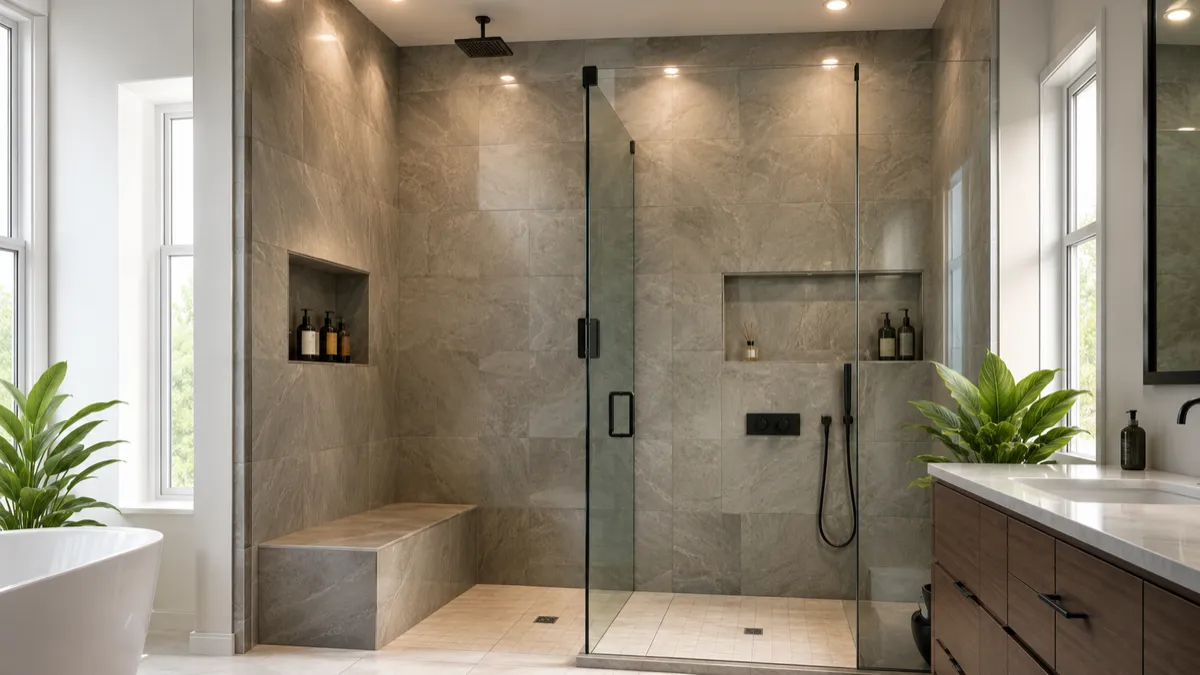
The step-over. A tub wall is the thing you climb, and climbing it means lifting a leg over a barrier on a wet surface with nothing much to hold. A walk-in shower removes that barrier entirely.
That is a change to how the room is used, and unlike a friction coefficient it is something you can see and try for yourself before you decide.
Our Warranty
Lifetime warranty covering plumbing, wall systems, fixtures, shower pan, doors and installation. Transferable to a new owner, backed by RenewItHQ, documented in writing. Only exclusion is customer damage.
What we will and will not tell you
We will not tell you a shower floor prevents falls. Nobody can tell you that, and the standard itself says the measurement does not predict whether a person will slip. What we will tell you is how the surface is made and why it is moulded in rather than painted on. When a consultant is out, put your hand on the surface. That is still a better test than a decimal.
Talk It Through in Your Own Bathroom
We look at the space, answer the questions this guide raised, and explain the options that fit your home.

Ready When You Are